Source: Moms First
A report from Moms First shows that providing child care benefits to employees can help stabilize the workforce.
A report from Moms First shows that providing child care benefits to employees can help stabilize the workforce.

©$year Pivotal Ventures

Editor’s Note: “Workplace Innovators” is a new series brought to you by the Workplace Innovation Now (WIN) Challenge and features influential voices and perspectives that are rethinking the future of work.
If you want to understand the next big shift in the workplace, don’t look at what happens in the office. Look at what happens at 7 a.m., when an employee tries to line up emergency child care before a morning meeting. Or at 8 p.m., when her elderly father falls and she finds herself answering emails in a hospital waiting room. Or at midnight, when she’s lying awake worrying whether her job is at risk because of the time she’s spent looking after her family, and how she’ll afford the care they need.
For too long, moments like these have been treated as private challenges for employees to manage quietly, on their own. But that assumption is starting to break down, and that’s the shift I’m hopeful about. Caregiving is increasingly being recognized as a collective responsibility—one that employers, policymakers, and investors all have a role in addressing.
That recognition, though, hasn’t yet translated into durable action, even as the need grows. There are 130 million people in this country caring for their children, older relatives, or loved ones with disabilities. That’s about three in every four workers. Yet our workplaces were never designed to support that reality.
People essentially doing two full-time jobs—one paid, one not. Cutting back on basics to cover the costs of care. Missing out on promotions, reducing hours, or leaving the workforce altogether. In a recent survey, 42% of women who chose to leave their jobs said caregiving was the main reason.
When this happens, families aren’t the only ones affected. Companies lose out on experienced talent, and the leadership pipeline shrinks. We all miss out on what these people could have contributed.

When millions of workers—especially women—left jobs to care for others, employers could no longer look away. Many began offering flexible schedules and remote work, opening up new opportunities. But in recent years, a lot of that flexibility has been retracted, and companies have rolled back paid leave too, contributing to the exodus of hundreds of thousands of women from the workforce.
Smart employers understand that caregiving shapes who can work, how they show up, and whether they stay. They understand that supporting caregivers isn’t just the right thing to do—it’s a good business decision. And that’s measurable.
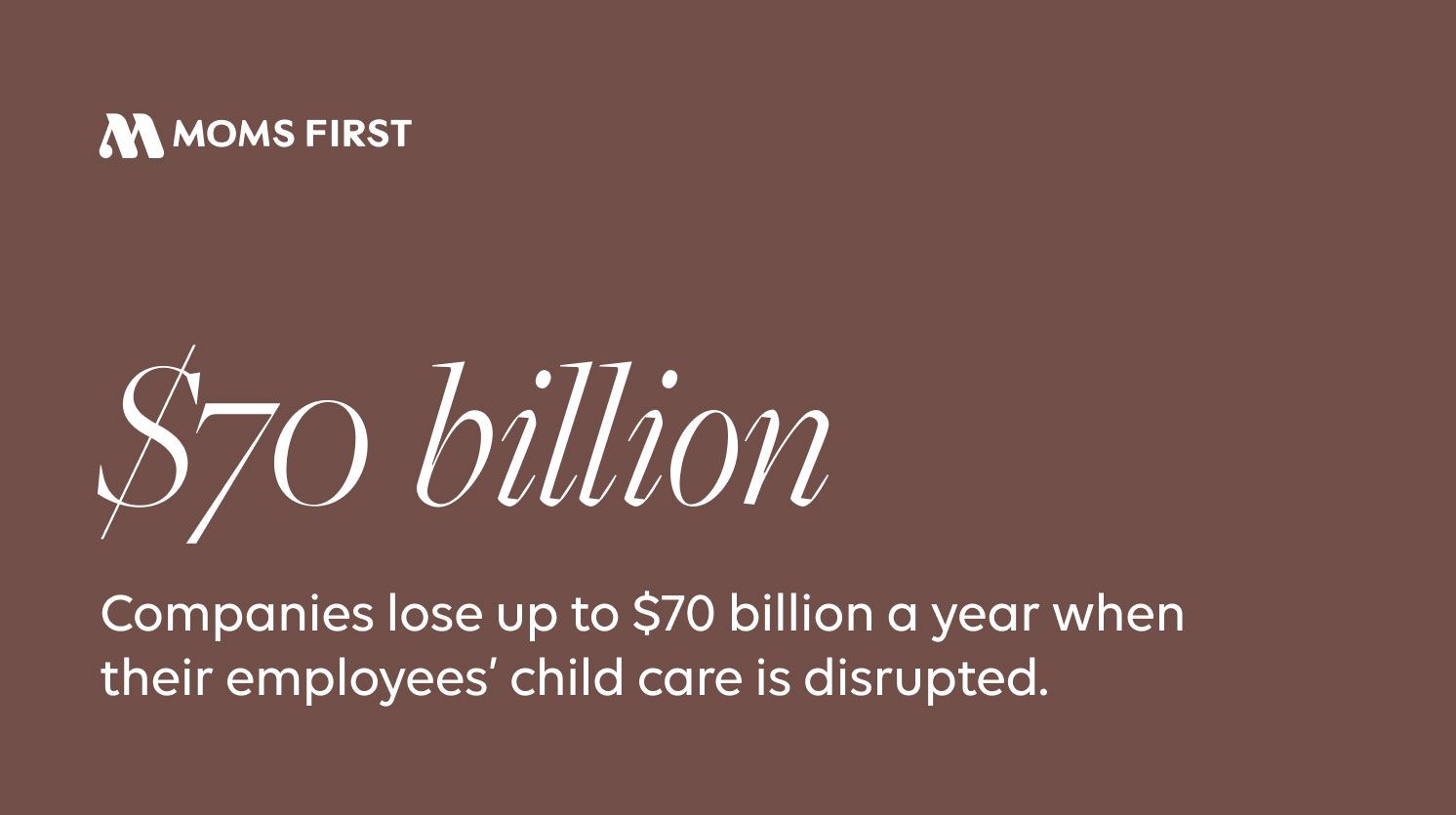
A report from Moms First found that companies lose up to $70 billion a year when their employees’ child care is disrupted. Research from Harvard Business School shows that when companies offer support for employees caring for children and older people, they see higher retention and engagement and avoid the real costs of workers being stretched too thin, like absenteeism, turnover, and lost productivity. It’s a clear financial opportunity: Businesses stand to recoup more than $4 for every $1 they spend on child care benefits.
Between an aging population, a growing sandwich generation, and the rising cost of care, there’s never been a more important time to invest in solutions that actually meet the scale of the need.
In addition to flexible work arrangements, some companies are meeting caregivers where they’re at with expanded benefits, like back-up care and access to care navigation services, and approaches to scheduling that enable caregivers, and all employees, to plan ahead.
Employers aren’t the only ones making change. Public policy is evolving, too, with more states expanding paid leave. (Virginia recently became the 13th state to establish a paid family leave program.) And there’s growing recognition that the care economy itself is a major driver of growth and opportunity. New investment and innovative models—like tech-enabled platforms that help families manage care—are beginning to reshape what care can look like.
At Pivotal, we’ve partnered with Aspen Digital to support even more solutions through the Workplace Innovation Now (WIN) Challenge. The $60 million dollar grant competition will find and scale ways to remove barriers for women in the workplace—including the impact that caregiving responsibilities have on women’s career opportunities.

If caregiving is going to be treated as essential infrastructure, leaders will need to go further: More comprehensive paid leave policies. Approaches to scheduling that allow workers to plan for care and step away in urgent moments. Benefits that make caregiving support easier to access. Workplace culture where employees don’t feel pressure to hide the fact that someone else depends on them.
It’s an exciting time for the caregiving sector, but also a precarious one. We have the chance to solve a crisis that has held back women and families in this country for decades—but only if leaders step up and give this issue the attention it deserves.
Between an aging population and the rising costs of care, the pressure on workers is only going to grow. But so will the opportunities to build workplaces that actually support how people live. That’s an investment we can’t afford to ignore.
Learn more about women in the workplace