

©$year Pivotal Ventures
“Start With the Teen and Not the Tech”
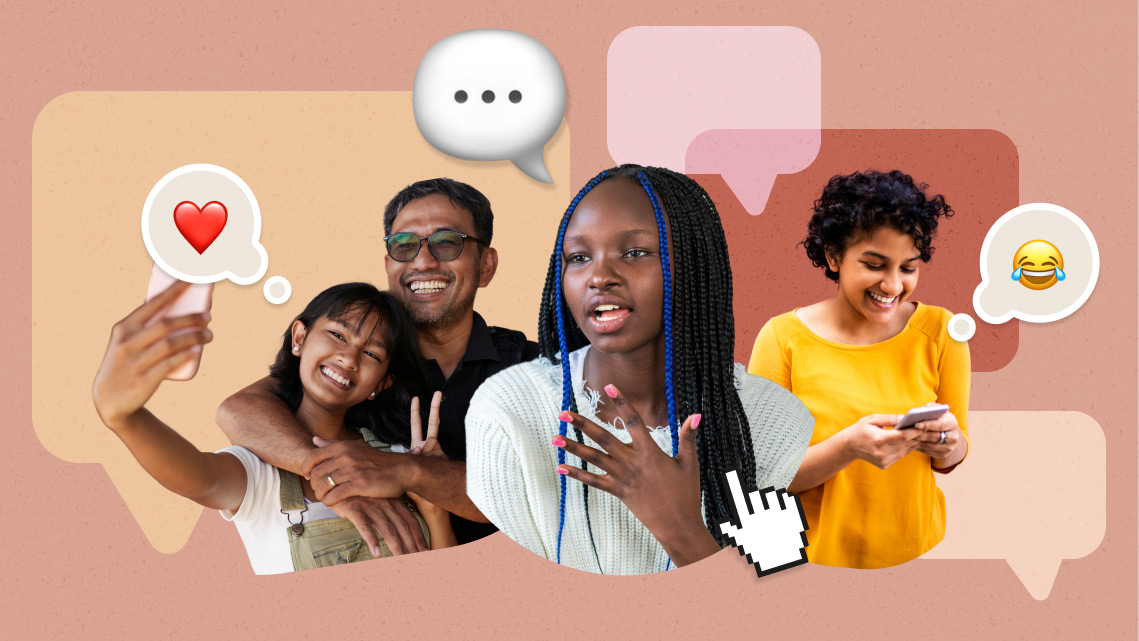
Photos by Klaus Vedfelt, Courtney Hale, and MStudioImages via Getty Images
The teenage years have never been easy. But now nearly four in five teens report feeling intense pressure in their lives—pressure that can feel more relentless, more visible, and harder to escape than ever before.
Online spaces have enormous potential to help young people mitigate those pressures, through creative outlets, meaningful social connection, and opportunities for self-expression. But too often, they can reinforce the very stressors young people are trying to manage.
Dr. Emily Weinstein of the Center for Digital Thriving at Harvard Graduate School of Education and Katya Hancock of the nonprofit Young Futures—Pivotal partners—are working to ensure that the relationship between teens and technology supports their well-being rather than putting it at risk.
Both have built their work on an often-overlooked premise: that the real experts on teen digital well-being are teens themselves. By centering young people’s perspectives, they’ve learned a lot about how we might begin to address these problems—both at a systemic level and through the everyday relationships that shape teens’ lives.
We recently sat down with Emily and Katya to dig into what they’ve learned. The picture they paint is daunting. But it’s also full of hope.
This conversation has been edited for length and clarity.
Both of your organizations were founded in 2023. In a nutshell, what was the problem that you felt called to solve?
Katya Hancock: This is the first generation growing up in a fully immersed digital world, and the systems around young people haven’t caught up to support them. When we started, there was already an incredible amount of work happening, but it was fragmented. A lot of it was shaped by adult assumptions instead of young people’s lived experiences. We felt a clear need to shift that, listen to young people, and fund solutions built with them and not for them. We wanted to change the narrative from panic and crisis to agency, possibility, and optimism.
Emily Weinstein: We founded the Center for Digital Thriving because the divide between adults’ good intentions and youth-centered insights is just too wide. Adults have a lot to say about teens and technology, but most of us spend far less time in listening mode. What teens tell us is more interesting, more textured, and more useful than the conversations that most adults are having.
When adults talk about teens and screens, what’s the most important thing they’re oversimplifying, or getting wrong altogether?
Katya: There’s a big difference between one teen doomscrolling alone all night and another using social media to find community. But a lot of conversations around teens and tech flatten all that into one thing. We wind up with blunt solutions that miss the point and miss lived experience. And if you’re placing all of the blame for young people’s struggles on screens, you’re not looking at everything else the young person could be struggling with.
Emily: When we use one-size-fits-all approaches, we crowd out space for understanding who’s most vulnerable and what’s most needed for them. We miss chances to see where teens’ realities might actually depart from our assumptions.
Katya, you spend a lot of time thinking about digital tension—the difficulty of stepping offline, even if you really want to—because so much daily life now happens in digital spaces. What makes that particularly challenging for teens?
Katya: Stepping offline is hard for adults, too. But for teens, tech is the scaffolding of their lives. Stepping off tech can mean disappearing from their social world. And remember, developmentally, a teen’s sense of belonging is so critical to their well-being. Opting out isn’t neutral. It really has a social cost.
We have heard from teens who say, “I know I’m on my phone too much. I would like to have a better relationship with tech. But I tried to take an Instagram break, and then I joined a club in high school, and all the communications were through Instagram.” It’s not easy for them. They put on “Do Not Disturb” and go to bed. They miss out on a whole group chat and they’re in the dark in the morning. Digital tension isn’t irrational. It’s very, very real.
There’s a lot of attention on AI right now. From your vantage point, does AI introduce fundamentally new risks for teens, or does it mostly intensify the challenges that were already there?
Emily: AI is not social media 2.0, yet I worry that we’re at risk of repeating some of the same mistakes. For social media companies, adolescent development was consistently an afterthought. In some cases, design decisions were intentionally made to play on developmental sensitivities because that drove engagement. While increased engagement is a win for social media companies, it could be a systematic loss for teen well-being. We need to look back over the lessons from social media so that we don’t just sleepwalk into the same mistakes.
Katya: It’s not social media 2.0, but it is accelerating a lot of what is already hard about social media. There’s more content, more personalization, more AI slop, and it’s harder to tell what’s real versus what’s AI-generated. It’s also introducing new dynamics around safety and risk, like with AI companions, deepfakes, and systems that can think and respond for you.One other thing we’re really paying attention to is offloading the development of critical thinking skills and cognitive ownership. We collaborated on a report with Surgo Health, and found that some young people are already questioning whether ideas shaped with AI still feel like their own. How does that fit into their confidence as an independent thinker? We also heard things like, “When I have a fight with my best friend, we put it into GPT, and it tells us who’s right.” It’s making your judgments for you. In time, that could significantly impact the ability of this generation to participate in communities and even a healthy democracy.
"Adults have a lot to say about teens and technology, but most of us spend far less time in listening mode."

Young people’s experiences range widely depending on the lives they lead. What can you tell us about how teens’ individual backgrounds and offline challenges shape how they experience online spaces?
Katya: The internet reflects and often amplifies the realities and challenges that young people are facing. For some people, online spaces are a lifeline. For example, if you’re LGBTQ+ and living in a place that doesn’t support your identity, it can be the only place to find support and community. But for young people who are already struggling with anxiety and depression, unchecked access to social media can make those conditions worse. And race, gender, family stability all change what you see, how you’re treated, and what you get out of online spaces. The bottom line is, we can’t have one-size-fits-all solutions.
Emily: Here’s one way to think about this that came out of our research: Start with the teen and not the tech. Young people are not a monolith, and they need different approaches that meet them where they are. When we look more holistically, and when we take a more teen-centered approach, we’re poised to understand the interventions that are most needed. Plus, young people have told us repeatedly that the adult tendency to separate “online” and “offline” life doesn’t match what they experience.
Let’s zoom out. What can you tell us about how we build structural solutions, so this doesn’t fall on individual parents and caregivers to figure out alone?
Katya: We need to build supports for parents and caregivers, but we have to stop putting this all on parents and caregivers—which is what something like a social media ban does. It lets everyone else off the hook, including tech companies.
Right now a lot of the conversation is focused on downstream fixes: screen time limits, parental controls, digital literacy. Those things matter, but they’re often treating symptoms and not the underlying conditions. The real question is, what’s actually driving the things young people are struggling with, like social connection, pressure, identity? And how is tech amplifying or alleviating those things? We need digital literacy in schools. But we also need community-rooted programs and solutions.
Emily: Our team has been inspired by what happened with driving. Decades ago, the industry saw safety as something that wouldn’t sell. Today it’s a competitive advantage and a selling point. We had interventions like seatbelts and airbags, and car manufacturers actually started competing to be the safest vehicles on the market. And we got ratings that gave consumers key information. This collectively moved the ecosystem.
I am so craving this kind of shift in tech. Imagine a world where we had Instagram and TikTok competing on who best supports young people’s well-being? What if we all expected that from AI companies, too? I believe this is possible, but it is going to take an all-hands-on-deck ecosystem shift, where pressure comes from all angles and we move towards a very different set of market forces.
"The number one thing we'd love to see is for young people to feel like they have agency in their digital lives."

We can all agree that the best solutions are designed with teens, not for them. So what’s a promising program or practice you’ve been working on that might not exist if you hadn’t engaged young people?
Emily: Not long ago, a teen shared a story with us about someone who had used ChatGPT to write an anniversary card for his wife. She was so moved by the card that she cried. The teens in the group were processing what they thought of that. Is it cool that AI wrote an anniversary card? What struck us was how differently groups of teens were approaching the issue. Some were focusing on the outcome: The card made her happy, so the AI use was good. Others were thinking, it’s okay to have some help, but writing the whole card?
That led to creating a resource we call Align on the Line. It’s a tool for teachers and students to have a discussion and come to consensus on where to draw the line on using AI for a given assignment. It opens up the exact kind of conversations that young people are telling us they need. And it does it in a way that strengthens the relationship between adults and young people.
When you imagine success in five or ten years, what do you hope is different for teens and families?
Katya: The number one thing we’d love to see is for young people to feel like they have agency in their digital lives—to see that tech is not something that’s done to them, it’s something that they feel in control over, so they can minimize risks and lean into all of the benefits.
Emily: I hope in five or ten years I tell young people that I want to hear about their pain points with tech and they roll their eyes! They don’t even know what I’m talking about because we’ve done so much better. I think that’s possible. Our team is going to keep listening a lot until we get there.
Visit the websites of Center for Digital Thriving and Young Futures to find evidence-based resources for individuals and organizations.